Arrow Spine and FOC
What Is Arrow Spine?
Arrow spine is a characteristic that describes how much an arrow shaft bends when a force is applied. Spine values like 500, 800, or 1100 are used to indicate this flexibility.
Each number refers to how far a 28” shaft bends when a 1.94 lb (880 g) weight is suspended from its center.
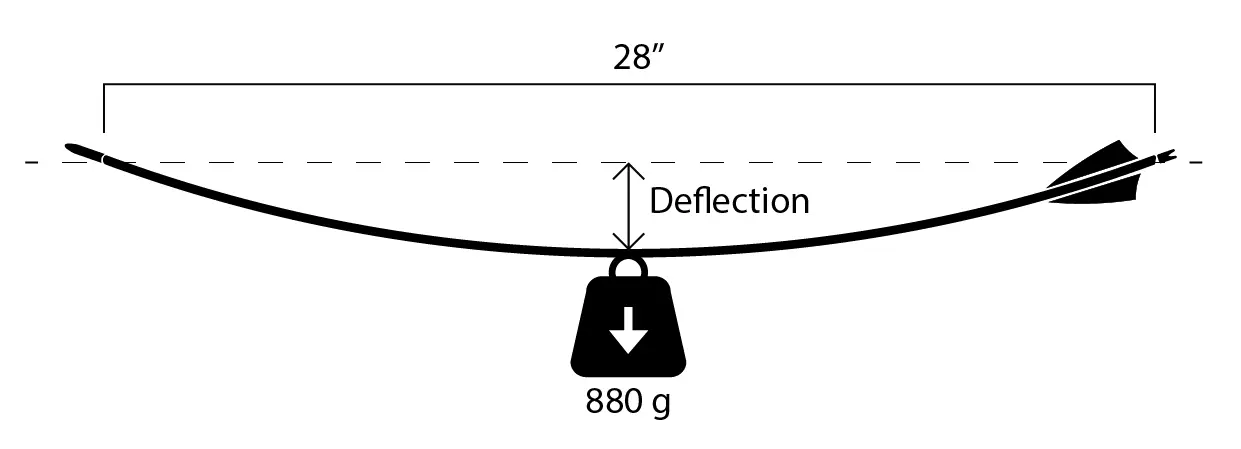
For example, if the shaft bends 0.7 inches, that corresponds to a 700 spine. The lower the spine number, the stiffer the arrow.
This measurement is called static spine — it describes the shaft’s behavior at rest. But when a shot is taken, the arrow bends dynamically, which is influenced by other factors — that’s the dynamic spine.
What Is Dynamic Spine?
Dynamic spine depends on:
- bow draw weight
- arrow length
- point weight
The longer the arrow or the heavier the point, the more it bends under load — meaning it behaves as if it were softer.
For example, a 28” shaft with a static spine of 700 will behave stiffer with an 80 grain point and softer with a 100 grain point
Why? Because at the moment of release, the force from the bowstring pushes the nock end forward. A heavier point resists acceleration more strongly, causing the shaft to bend more.
The same goes for length: a longer shaft is easier to bend, so dynamic spine decreases as arrow length increases.
How to Choose the Right Spine
It's important to understand: there is no exact formula to calculate the perfect spine. Instead, experienced archers and manufacturers use proven charts and guidelines.
For example, with a 27” arrow and a 37 lb draw weight, a spine of 700–800 is usually appropriate.
If the spine is wrong:
- the arrow won’t stabilize in flight
- groups will scatter
- and tuning becomes nearly impossible
Every arrow brand provides a spine chart, which recommends shaft stiffness based on shaft length and draw weight.
You can also use the spine calculator to calculate the ideal spine based on:
- shaft length
- bow weight
- point weight
- fletching weight
What Is FOC?
If you realize your arrows are too stiff, you might be tempted to just add more point weight to soften the dynamic spine.
That’s possible — within limits. Why? Because of FOC.
FOC (Front of Center) is a measurement that shows how far forward the center of mass is from the arrow’s physical center.
The formula is:
FOC (%) = 100 × (Balance Point − (Arrow Length / 2)) / Arrow Length
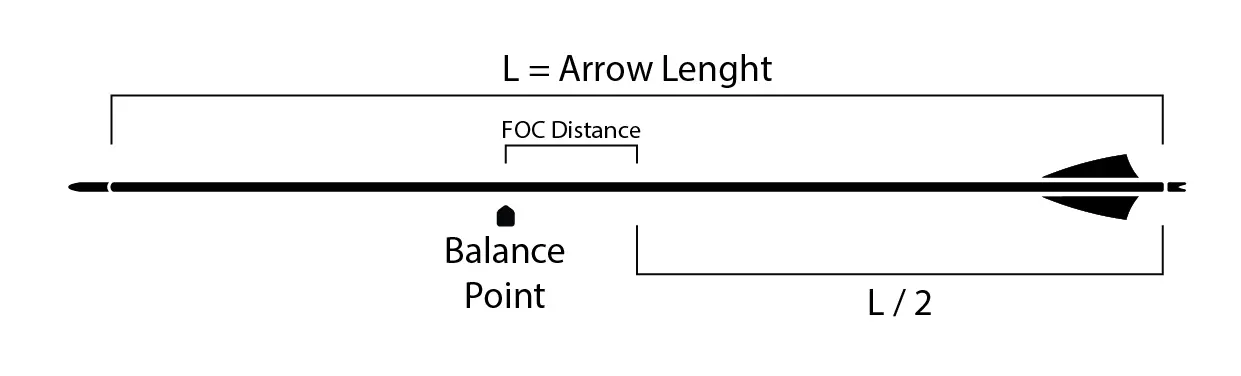
So FOC tells you how far the arrow’s balance point is shifted toward the tip. Recommended FOC for recurve bows: 10–15%
If the point is too heavy, FOC increases beyond optimal range. This can affect:
- trajectory
- arrow flight stability
- and consistency at longer distances
Conclusion
Spine and FOC are two of the most important aspects of arrow tuning.
When choosing new arrows or modifying existing ones, always:
- consider bow weight
- arrow length
- point weight
- and calculate the final specs
My website offers spine and FOC calculators to help you find the right arrows.
A well-tuned arrow is not just about stiffness — it’s about balance. When you tune your arrows, you’re tuning your entire bow system.