Plunger and Nocking Point Height
What the Plunger Is For
When the string is released, a force acts on the arrow from the nock toward the tip.
For right-handed archers, this force vector is slightly angled to the right due to the string being released by the right hand. This causes the arrow to press against the riser and bend (flex). How much it bends depends on its spine (stiffness):
- If the arrow is too soft, it will bend excessively, making it hard to stabilize in flight.
- If the arrow is too stiff, it won’t flex enough and will bounce off the riser to the left.
The plunger compensates for this effect.
During the shot, the arrow presses against the plunger button, which compresses slightly depending on its tension setting. This softens the impact against the riser and helps guide the arrow more cleanly.
- For soft arrows, increase the plunger stiffness.
- For stiff arrows, decrease the stiffness.
Nocking Point Height
The height of the nocking point is measured from a horizontal line between the rest and the string. It is typically set 3–10 mm above that line.
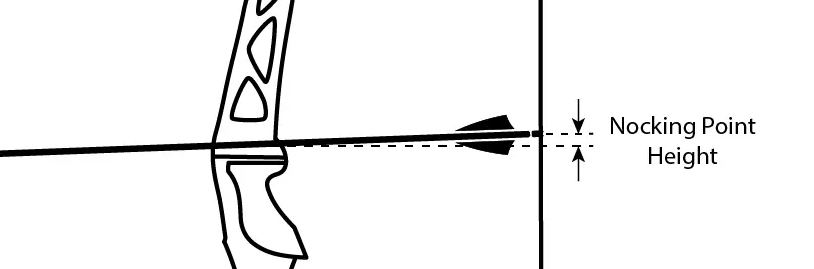
Why above? Because when the bow is drawn, the string nock point drops slightly, and this elevation compensates for that movement.
Tuning the Bow (Bare Shaft Test)
The best way to find the correct nocking point height and plunger tension is through bare shaft tuning — using an arrow without fletching.
How to Make a Bare Shaft Arrow
- Take an arrow identical to your regular ones in length, spine, tip weight, and total mass.
- Find the center of gravity (CG) of a fletched arrow and mark it.
- Take an identical arrow without fletching, and mark the same CG.
- Add tape to the back of the shaft (where fletching would normally go) until the CG aligns with the mark — this ensures the same balance.
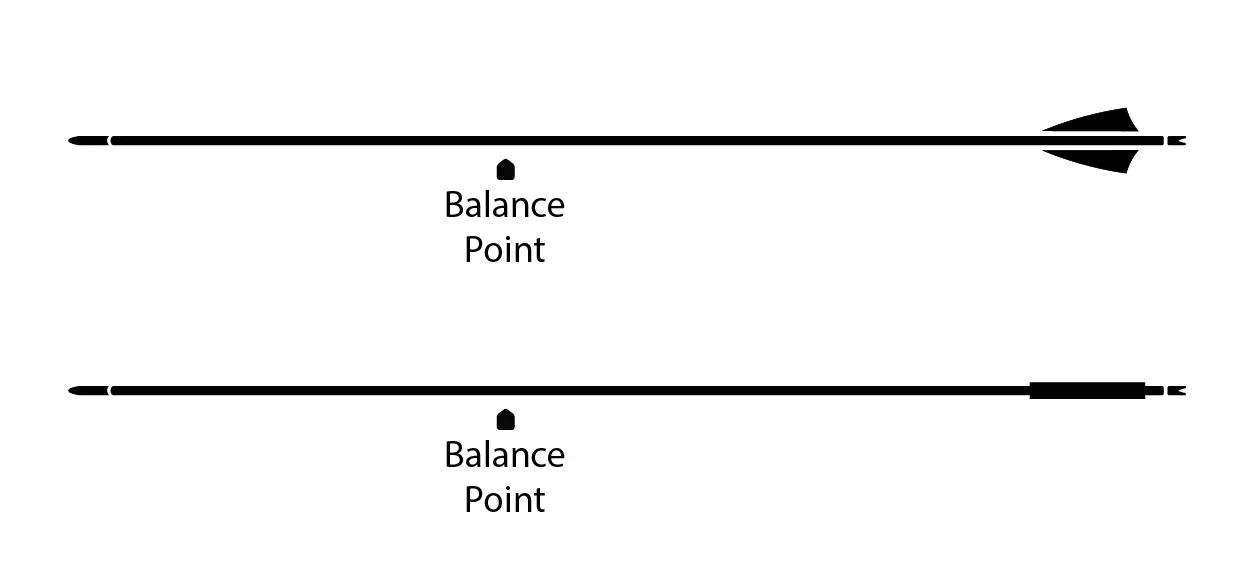
A bare shaft like this shows how the bow affects the arrow in flight — since there is no fletching to correct its path, any deviation comes from the setup.
Bare Shaft Tuning Procedure
- Start at a short distance (3–5 meters) to avoid missing the target. Then gradually increase to 18 meters or your desired range, stepping up by 3–5 meters.
- At each distance:
- Shoot several fletched arrows, aiming at a single point. They should group tightly.
- Shoot the bare shaft arrow at the same point.
- Analyze where the bare shaft lands compared to the group.
- Adjust the nocking point height or plunger tension as needed.
- Repeat the test at the same or greater distance until tuning is complete.
Interpreting Results
| Bare Shaft Lands | What to Adjust |
|---|---|
| Higher than the group | Raise the nocking point |
| Lower than the group | Lower the nocking point |
| Left of the group | Soften the plunger (reduce stiffness) |
| Right of the group | Stiffen the plunger |
| Inside the fletched group | Setup is correct — move on or finish tuning |
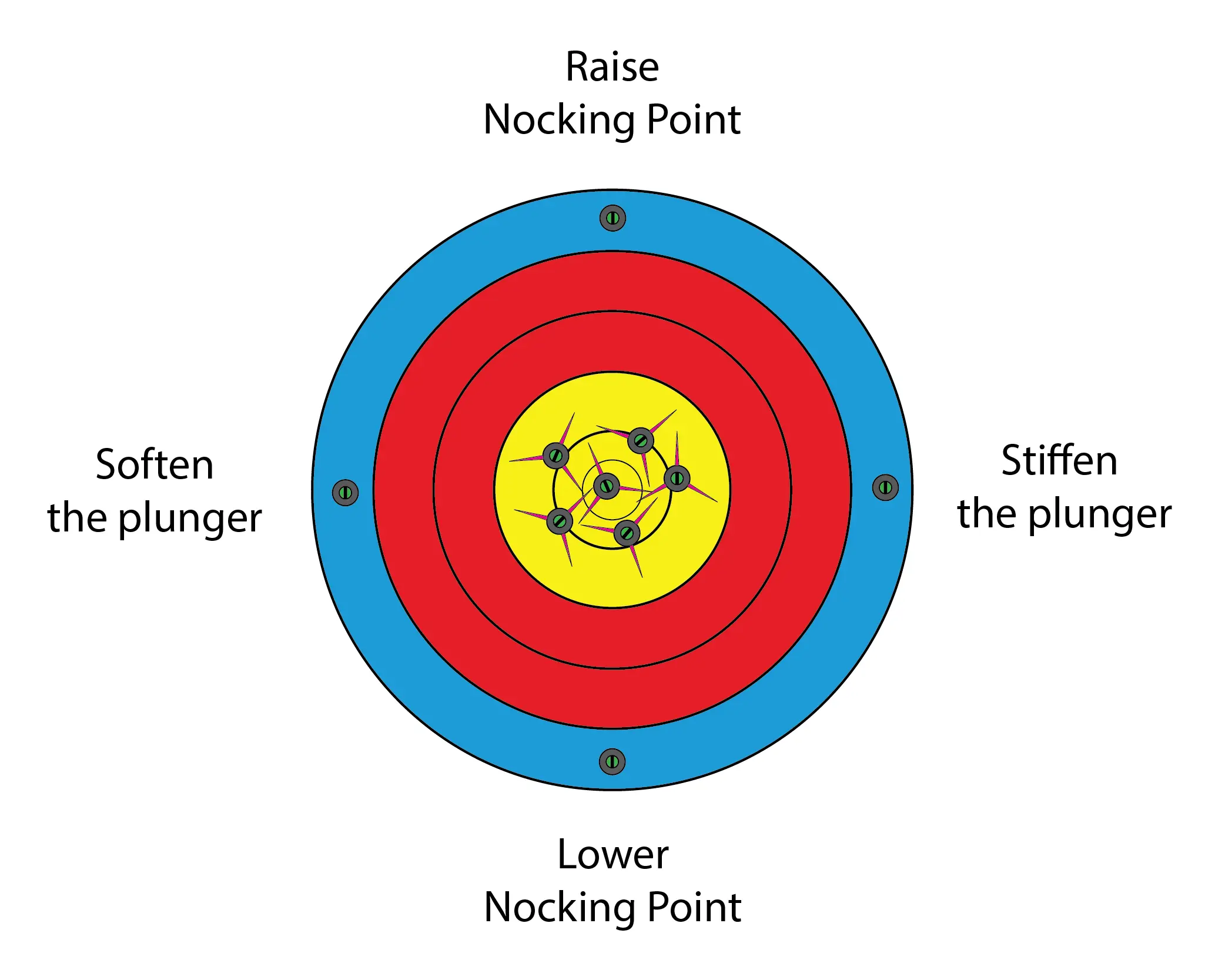
Once the bare shaft hits the center of the fletched group consistently at your target distance — your setup is properly tuned.